Architect or Architectural Technologist: which one do you need for your extension?
For an extension, you can choose between an Architect or a Chartered Architectural Technologist. The law asks for competent design, not a particular title. The practical difference, explained.
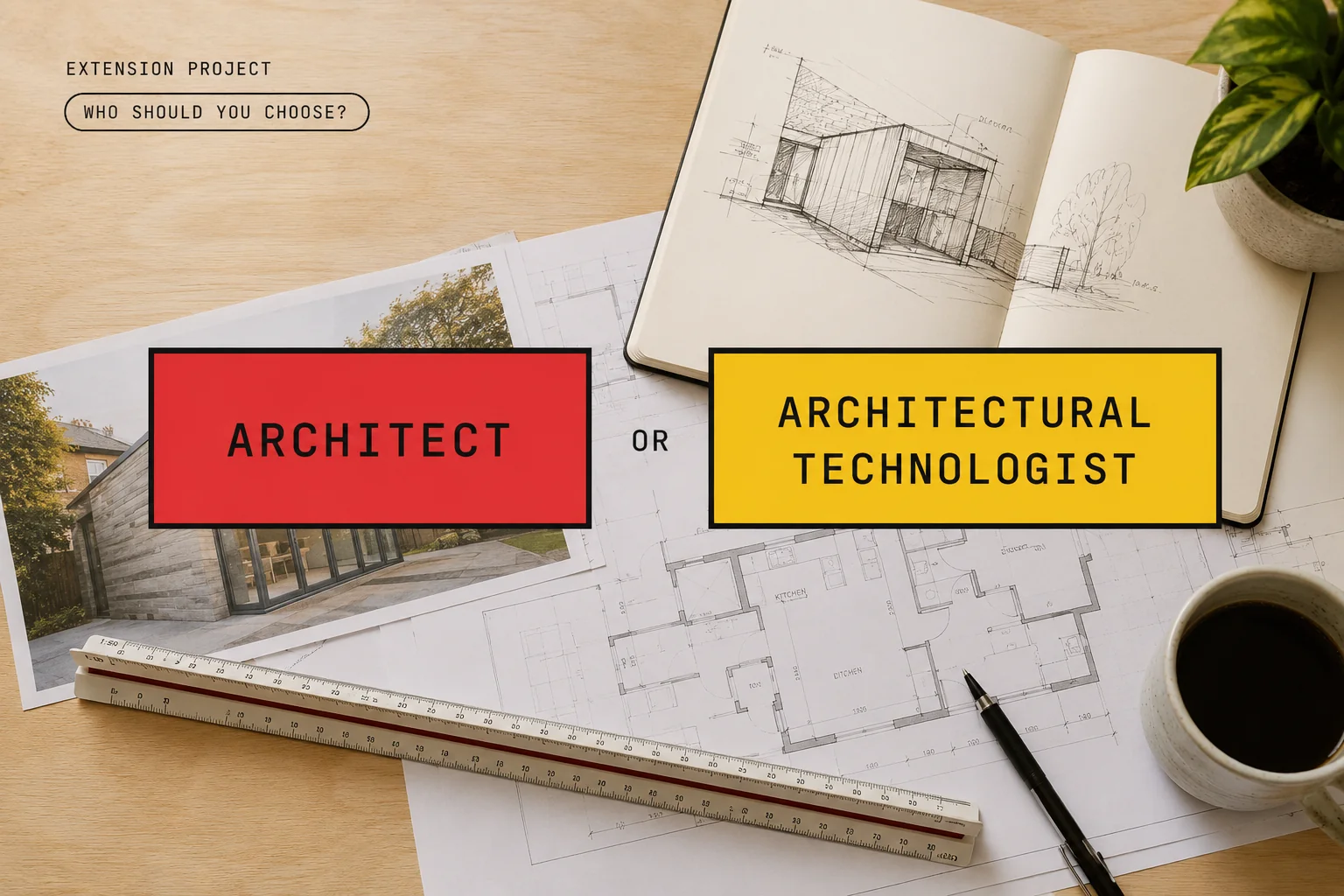
For an extension, you have a genuine choice of professional. An Architect or a Chartered Architectural Technologist could be equally well placed to design your home extension. Building regulations ask for drawings and specifications from a competent Principal Designer and a competent consultant team — the test is competence, not a particular title. A Chartered Architectural Technologist meets that test in full. That’s the short answer.
The longer answer is worth five minutes, because the two professions are genuinely different, and the difference can matter depending on your project.
One disclosure before we start: I am a Chartered Architectural Technologist, so I have a horse in this race. Weight what follows accordingly. Every claim here can be checked at source: with the Architects Registration Board, the statutory regulator for Architects, and with the Chartered Institute of Architectural Technologists, the chartered body that assesses and disciplines Architectural Technologists.
The practical difference
An Architect is registered with the Architects Registration Board (ARB), and the title is protected by the Architects Act 1997: only a registered person can use it. An Architectural Technologist charters with CIAT and uses the protected designation Chartered Architectural Technologist, or MCIAT. Two registers, two protected titles, two routes in.
Both design domestic extensions. Both prepare drawings for planning and building regulations. Both can act as Principal Designer under the Building Safety Act 2022, a role required on virtually every domestic extension.
For a homeowner, the differences that actually matter come down to three things:
- Training route. Architects complete the Part 1, Part 2 and Part 3 pathway: typically seven years, weighted towards design theory and practice. Architectural Technologists complete a CIAT-accredited degree and a professional assessment centred on the technology of building design: construction detailing, materials, regulatory compliance.
- Emphasis. An Architect’s training leads with the design concept. A Technologist’s training leads with how the building goes together and how it satisfies the Approved Documents. Both cover both. The weighting differs.
- Capability for domestic work. For extensions, loft conversions and building regulations submissions, the overlap is near-total. Neither title is less qualified. They are differently qualified.
Which do you need?
For most domestic extensions in Haywards Heath, Burgess Hill, East Grinstead and the surrounding villages, either professional can take your project from first sketch to completion certificate. Both are professionally assessed. Both answer to a code of conduct with a disciplinary process behind it. Both are required to carry professional indemnity insurance. ARB requires it of registered Architects, and CIAT requires it of its Chartered Practices.
So the title on the letterhead might be the wrong question. A more useful question may be what your project leads with: technical delivery, or design concept.
Technical delivery means an extension that has to negotiate the Approved Documents, a loft conversion where the staircase and fire strategy decide whether the scheme works at all, or a building regulations package that building control will approve first time. That territory is the core of a Technologist’s training rather than an adjunct to it. The day-to-day language of Part B, Part L and the building control submission is the job, not a department of it.
If it leads with concept, the balance shifts. A large new-build development where the architectural vision drives everything, listed building work where heritage sensitivity is central, a complex site that needs design thinking before it needs detailing: for those, a registered Architect may be the stronger fit, and we would tell you.
For the vast majority of domestic projects, though, what you need is a competent, chartered designer with a track record in your type of project. Both routes produce that person. Check the register, look at the built work, and choose the individual.
Frequently asked
Do I need an Architect for an extension?
Not necessarily. An Architect can design your extension, and so can a Chartered Architectural Technologist. Building regulations ask for drawings and specifications from a competent Principal Designer and a competent consultant team; both professions can meet those competence requirements. The right choice depends on the project, not the title.
Is a Chartered Architectural Technologist qualified to design my extension?
Yes. MCIAT is the recognised professional qualification for the design and technical management of building projects. CIAT assesses chartered members for competence and requires its Chartered Practices to hold professional indemnity insurance.
Can an Architectural Technologist act as Principal Designer?
Yes. Both ARB-registered Architects and CIAT-chartered Architectural Technologists can be appointed Principal Designer under the Building Safety Act 2022, provided they hold the relevant competence for the project in hand.
Can every Architect and Architectural Technologist act as Principal Designer?
No. Chartered membership does not guarantee competence for the Principal Designer role. Under the Building Safety Act 2022, competence belongs to the individual and the organisation, and it must be assessed relative to the project: the right skills, knowledge, experience and behaviours, known as SKEB, for the work in hand. As the client, you are entitled to ask your chosen professional for evidence of their SKEB as part of their appointment. A competent professional will expect the question and have the answer ready.
Can I act as my own Principal Designer?
In principle, possibly — but it is not recommended. There is currently no restriction on who can be the Building Regulations Principal Designer, provided they hold the necessary skills, knowledge, experience and behaviours (SKEB) for the project. With a competent adviser alongside you, it can be argued the role is fulfilled in line with the legislation.
In practice, it carries significant risk. The duties, and the liability, sit with whoever holds the appointment. We always recommend appointing an Architect or Chartered Architectural Technologist who can demonstrate the relevant competence, and keeping that appointment in place throughout the design and construction phases.
Can my contractor be the Principal Designer?
Only if they are genuinely the designer in control of the design. The Building Regulations Principal Designer must be a designer — actively involved in design work, not just managing it. On a design-and-build project, where the contractor holds the design, they or their in-house team can take the role, provided they have the competence for it.
On a typical domestic extension, though, you appoint a designer and a builder separately. There the contractor is the Principal Contractor — the construction-phase role — and your designer is the Principal Designer. Keeping each role with the person actually doing that job is usually the cleaner, lower-risk arrangement. One word of caution on design-and-build: the Principal Designer duty cannot be passed down a chain of sub-consultants, so it stays with whoever you appoint directly — and it is they who must be able to demonstrate the required competence.
On very small refurbishment works, some contractors are choosing to accept the role of Principal Designer. Some contractors will have the prerequisite competences, many will not. This is an area of significant risk. If this is a service you have been considering, we can assist by taking on the role — but only if works have not already commenced on site.
How do I check someone’s credentials?
Two minutes online. Architects appear on the ARB register; Chartered Architectural Technologists on the CIAT directory. If a designer’s name isn’t on either, ask why.